
When surgical
complexity rises,
efficiency matters.
Europe’s ageing population is driving an increase in both the demand for surgery and complexity of procedures.1 As hospital reimbursement per case remains fixed, achieving better outcomes with existing resources has become essential.
TachoSil supports reliable hemostasis2-4 and tissue sealing,5-6 helping reduce variability linked to postoperative complications.
By minimizing complications, TachoSil may help reduce hospital stays by up to 11.8 days,2-3,7 supporting hospital efficiency and helping reduce surgical costs in an increasingly demanding healthcare environment.
 Faster hemostasis.
Reducing complications.
Shorter hospital stays.
Faster hemostasis.
Reducing complications.
Shorter hospital stays.
Reduction of complications reduces surgical costs.
Loss of efficiency due to complications.
Complications erode efficiency, extending hospital stays and consuming hospital capacity8. The occurrence of complications increase the cost by a factor of 2-4.9 The result is a deficit.
Reducing costs by reducing complications.
Avoiding complications reduces the length of hospital stay and lowers costs within the flat rate per case.2-3


TachoSil – reducing complications to protect hospital performance.
When standard techniques are insufficient, TachoSil supports reliable hemostasis2-4 and tissue sealing5-6. By helping surgeons control bleeding and leakage quickly, it reduces complication-related variability and supports shorter hospital stays2-3,7.
Shorter hospital stays from 0.5 to 11.8 days2-3. Proven with TachoSil.
2.4
2.7


3.0
1.3 – 1.6
Reduction in postoperative complications.
The rapid and safe reduction of clinical complications such as prolonged air leaks, urine leakage, lymphoceles, or even bleeding7,13,14 can enable earlier discharge of patients10,14-17 and minimize re-interventions.
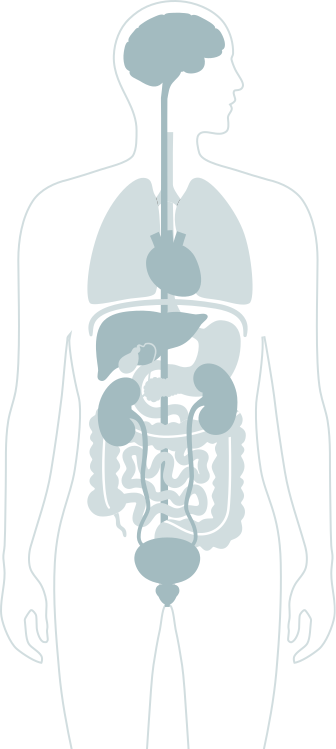

- Supportive mechanical sealing of the dura mater to reduce leakage18
- Significant reduction in length of hospital stay§,16
- Shortening of monitoring time in intermediate care units§,16
- Reduction in cost-intensive reinterventions due to supportive multilayer dura closure18

- Significant reduction in postoperative pericardial effusion volume and shortening of drainage duration#,10
- Significantly lower risk of (pre-)tamponades requiring pericardiocentesis10

- Significant reduction in air leak intensity13 and duration14,17 as well as reduction in leakage rate in complex reoperations6
- Shortening of drainage duration and accelerated discharge of patients&,14,17
- Significant reduction of procedural costs through efficient complication management17

Significant reduction in postoperative drainage volume compared to oxidized cellulose$,15

Process optimization through catheter-free PCNL and early discharge of patients5
Reduction in drainage volume (e.g., Lymphatic adverse events (LAEs) after radical prostatectomy, laparoscopic partial kidney resection)19-20
Reduction in drainage volume (e.g., Lymphatic adverse events (LAEs) after radical prostatectomy, laparoscopic partial kidney resection)19-20
Efficiency in the operating room through faster hemostasis.
The adjunctive use of TachoSil supports faster hemostasis, helping to streamline surgical procedures and optimize operating room resources.
A trusted name worldwide.
Used in operating rooms around the world, TachoSil® stands for reliability, safety, and consistent surgical performance — wherever it’s needed.
References
1: European Commission: Green Paper on Ageing, 2021. Available at: https://commission.europa.eu/system/files/2021-06/green_paper_ageing_2021_en.pdf, last accessed on 12 January 2026 2: Colombo GL et al. Vasc Health Risk Manag. 2014; 10: 569-576
3: Colombo GL et al. Ther Clin Risk Manag. 2025; 21: 261-70
4: Briceno J et al. Arch Surg 2010; 145: 482-4
5: Cormio L et al. J Urol. 2012; 188(1): 145-50
6: Filosso PL et al. Interact Cardiovasc Thorac Surg. 2013; 16(5): 661-6
7: Summary of Product Characteristics TachoSil® sealant matrix, current status
8: Ladant FX et al. BMJ Surg Interv Health Technol. 2025; 7(1): e000323
9: Watson SL et al. Br J Anaesth. 2025; 135(6): 1753-1760
10: Onorati F et al. J Card Surg. 2008; 23(6): 531-6
11: Rena O et al. Interact Cardiovasc Thorac Surg 2009; 9: 973-977
12: Allama AM et al. Asian Cardiovascular and Thoracic Annals. 2019; 27(5): 369-373
13: Marta GM et al. Eur J Cardiothorac Surg. 2010; 38(6): 683-9
14: Anegg U et al. Eur J Cardiothorac Surg. 2007; 31(2): 198-202
15: Kakaei F et al. HPB Surgery. 2013; 2013: 587608
16: Hutter M et al. J Neurosurg. 2014; 121(5): 735-744
17: Droghetti A et al. Ann Thorac Surg. 2008; 86(4): 1126-31
18: Tamašauskas A et al. J Clin Neurosci. 2008; 15(11): 1273-7
19: Simonato A et al. Eur Urol. 2009; 55(1): 12-19
20: Tonyali S et al. Urol Int. 2016; 96(3): 328-33
21: Siemer S et al. Eur Urol 2007; 52(4): 1156-63;
22: Frilling A et al. Langenbecks Arch Surg 2005; 390: 114-20;
$: Kakaei F et al. 2013: RCT with limited sample size (n = 45), comparing TachoSil®, oxidized cellulose, and cyanoacrylate adhesive (n = 15 per group);
&: Droghetti A et al. 2008: Proven in pilot study;
Ø: Siemer S et al. 2007: Marginal prolapse study, TachoSil® vs. standard technique (suture), (n = 185);
‡: Frilling A et al. 2005: RCT, TachoSil® (n = 59) vs. Argonbeamer (n = 62).

- EMA SmPC: https://www.ema.europa.eu/en/medicines/human/EPAR/tachosil
- UK SmPC: https://products.mhra.gov.uk/search/?search=tachosil&page=1
- USA SmPC: https://www.fda.gov/vaccines-blood-biologics/approved-blood-products/tachosil
- Switzerland SmPC:
This website is intended for Healthcare Professionals only
This website is intended to provide information only to Healthcare Professionals. It contains information on TachoSil, which is based on the Summary of Product Characteristics as approved by the European Commission. The information on this site is not country specific and may vary from the approved product information in the country where you are located. Not all sizes and formulations of TachoSil are available in all markets. In addition, product names, trademarks, and visual identity elements may vary by country or region. Please, refer to your local Prescribing Information for full details.This website has been developed by Corza Medical in accordance with industry and legal standards. Corza Medical makes every reasonable effort to include accurate and current information; however, the information provided on the website is not exhaustive.By clicking “Yes, I am a Healthcare professional” you are declaring that you have read and understood this disclaimer and accept the terms.Switzerland SmPC - AIPS - EinzelabfrageRelevant for TachoSil only:If you would like to report an adverse event regarding TachoSil, please contact drug.safety@corza.comIf you have a medical inquiry regarding TachoSil, please contact medinfo@corza.comIf you would like to report a complaint regarding TachoSil, please contact: quality@corza.com


 service@corza.com
 +1-877-991-1110
 +1-610-404-4010